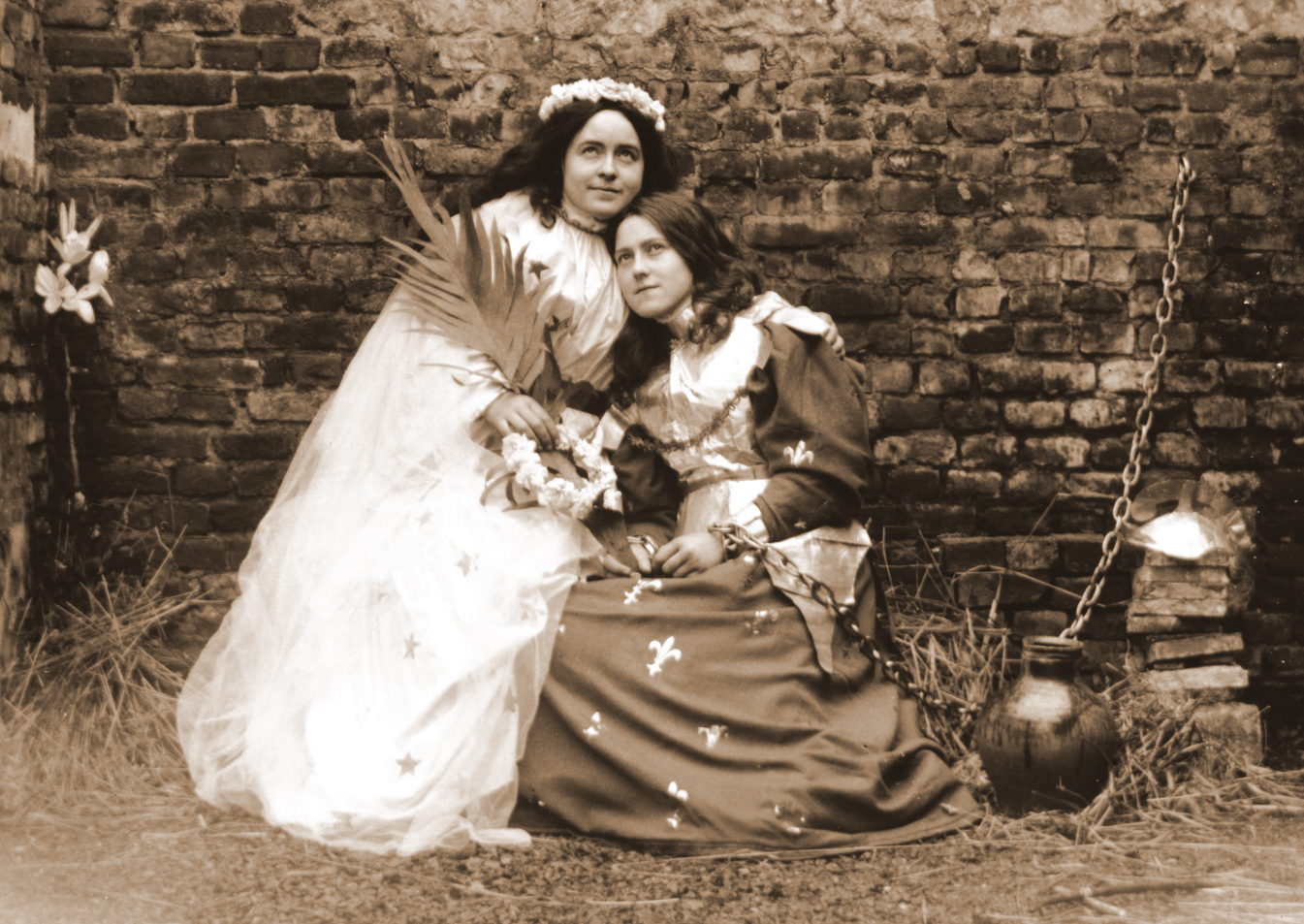
Céline and Therese posing together before the performance of a play about Joan of Arc written by Therese. The play was performed in honor of their older sister, Mother Agnes of Jesus (Pauline Martin).
The complete edition
The heart of an artist. The soul of a saint.
Two stories trace the life and eye of Céline Martin—from the camera she carried into the Carmel of Lisieux to a playful photographic adventure that quietly anticipated the language of cinema.
How the talents of Céline Martin gave us a window into the soul of a Saint
If she were a Saint, today would be her feast day.
That's because Saints are generally remembered on the day they died. And Céline Martin, also known as Sister Geneviève of the Holy Face, died on February 25, 1959, at the age of 89.
But there's always hope.
Her younger sister is St. Thérèse of Lisieux, her parents, Louis and Zelie, are Saints, and her older sister, Leone Martin (Sister Francoise-Thérèse of the Visitation at Caen), is a Servant of God.
Perhaps it's a matter of a miracle or two.
And if that day ever comes, perhaps she and St. Veronica can share the title of 'Patron Saint(s) of Photographers.'
But in the meantime, I suggest that she be honored with the title 'Patron Nun of Photographers.'
She may not have wanted that because even though her photographs are among the most recognized in the Catholic world, I think she'd rather be remembered for her unfaltering devotion to Christ.
Like I said, there's hope ;-)
Years ago, I was searching for a gallery of images of St. Thérèse of Lisieux and was surprised at how many high-quality photographs existed of her. Only a handful of Saints from the 19th Century were photographed. And even then, not more than once or twice. But in her case, there were dozens of photos spanning her entire life.
At the time, I didn't really appreciate the significance of how they came to be, or who took them, until I read a little bit of the autobiography of Sister Geneviève (Céline Martin), her sister-photographer-Sister.
Plate 02
Celine and Therese were inseparable in their youth until Therese left for the Convent. But they picked right back up when Celine joined her in the Convent in 1894.
Young Céline was a maverick. She had a tenacious spirit, an artist's heart, and an engineer's mind.
In her autobiography, she states, "I really liked making inventions and understanding the mechanism. Having had a sewing machine, I took it apart completely, and after cleaning each part, I put them back in their place. Speaking of the sewing machine, I also knew how to make it work, and often, our cousins and I made toilets for ourselves!"
She excelled in academics and won several prizes for excellence in mathematics.
Her talents were diverse—electroplating, sketching, photography—but painting held her heart. She received offers to study with the Master's at 'The Salon' in Paris and was even encouraged by her father, Louis. But after he offered his assistance for her to move, she revealed to him that she felt called to be a Nun.
Plate 03
Céline leads the way on an adventure, followed by her cousin Marie Guerin, and sister, Jeanne. She would ultimately lead them both into the Convent.
After his passing, she entered the Carmelite Convent in Lisieux, taking the name Sister Geneviève of the Holy Face, joining her sisters and cousin. Providentially, along with her abundant skills and talents, she was permitted to bring her cumbersome camera along with her, a simple gesture that would profoundly impact the world.
The camera was a 13x18 wooden box-type with a 'Darlot' lens. It used a dry-plate or 'tintype' process, also known as ferrotype. It was a 19th-century photography technique that created a positive image on a lacquer-coated metal sheet.
The process involves coating a thin iron plate with a light-sensitive collodion and silver nitrate mixture. This is exposed to light in a camera, then immediately developed, fixed, and varnished, resulting in a durable, detailed, and relatively inexpensive image.
But the process took a lot of work. Things would need to be thoughtfully staged and posed, and the subjects would need to stay unflinching for up to a minute due to the low light sensitivity of the media with an ISO of 1!
But as impressive as her skills were, it was where she was photographing that was that was groundbreaking.
Within the hallowed walls of a cloister.
Plate 04
This photograph of the Monastery is thought to be the first photograph that Céline took after she entered the Convent.
She was one of the very first people to photograph within a cloister and she was the very first Nun to photograph within a cloister. And being a member of the religious community gave her access to the heart of the Order. The inner workings. The inner life. And what a life it was.
After entering the cloister, she took 41 photographs that included her younger sister, St. Thérèse of Lisieux, chronicling her life and, ultimately, her death. Among the most famous, and by far the most creative images—were the photographs made on January 21, 1895, on the feast of St. Agnes.
Each year, the Carmelite community celebrated the feast day of the prioress, in this case, Mother Agnes of Jesus (Pauline Martin), their older sister. Thérèse contributed to these celebrations by writing and producing plays they would perform.
For Mother Agnes's feast, she produced a 'Joan of Arc' play. Céline joined the convent a few months earlier and played the role of St. Catherine…and photographer.
During one performance, Thérèse, portraying Joan, narrowly escaped being burned alive in an accidental fire where she stood unflinching, demonstrating her willingness to offer her life to God.
But beneath it all was Céline's abiding passion for Christ, as was evident from her writings: "From the moment we first seek his kingdom and his justice, he is happy with us. And I am certain that even in occupations which did not have eternity as their immediate goal, I always gave myself up to them with the intention of finding there some beauty which would bring me closer to my Creator. Besides, it wasn't difficult, everything raised me to him, even the things that naturally should have taken me away from him."
She spent a lifetime developing her God-given gifts while at the same time detaching from them in her heart to make room for Christ.
The heart of an artist with the soul of a saint.
In a world that often forgets the hands that crafted its memories, Céline Martin – an artist, a sister, and perhaps, a future patron saint of photographers, sharing the mantle with St. Veronica will not be forgotten.
And bound by her love of Christ, her closeness to her sister, and her skills as a photographer, she left us with more than images— but a window into a soul.
What I thought was a moment of history turned out to be something far more surprising—revealing the hidden artistry of Céline Martin. (Sister Geneviève of the Holy Face, Part II)
Plate 07
I like pictures.
On the wall of my office, I have a few that I return to often.
One is of the Blessed Sacrament, held in a monstrance at the Shrine in Hanceville, Alabama. I took it during adoration while I was there for Mother Angelica’s funeral. It’s the kind of image you don’t just look at, you enter it.
I also have a sketch of an old seventeenth-century galleon, braced against stormy seas. It sails hard into dark, tumultuous skies. I’ve always loved the sea… the mystery of it, the adventure of it, the sense that something is always just beyond sight.
And then there’s another image tucked a bit off to the side.
A photograph I’ve always loved.
For years, I thought it was a candid moment from another era. A little wild. A little mysterious. Céline Martin and her friends, standing on a bridge, brandishing rifles like explorers or revolutionaries. I even used it once in an article about the pursuit of excellence.
It felt real.
But it turns out…
As usual…
I was completely wrong.
Last year, while diving deeper into the life of Céline Martin—the sister of Saint Thérèse of Lisieux, better known as Sister Geneviève of the Holy Face—I stumbled onto something astonishing.
That photograph wasn’t documentary at all.
It was part of a play.
In July of 1894, Céline and some of her friends and family staged and photographed a twelve-scene production titled Voyage excentrique aux Cordillères des Andes—The Eccentric Voyage to the Andes. It was a kind of comedic “photo-theatre,” inspired by the Chilean travels of their friend, Abbé (Father) Joseph de Cornière, and performed on the Guérin family estate known as La Musse.
The troupe included the Abbé himself, Dr. Francis La Néele (Céline’s future brother-in-law), Marie and Jeanne Guérin, and Céline, armed with props, costumes, and a sense of gleeful adventure.
They weren’t crossing the Andes.
They were making up a story.
Creating a living photo-story decades before motion pictures existed.
Each scene was paired with a rhyming caption penned by the Abbé. The tone was whimsical, satirical, almost cinematic.
It begins like an expedition… and slowly unravels into delightful chaos.
The explorers lose their way. They tumble down ravines. They encounter a “panther.” They rescue one another with ropes. And finally, they return home—triumphant.
Reading the surviving verses feels like watching a silent film unspool…
“Down from the mountain’s craggy side Our gallant band descends once more, Through shadowed woods their steps they guide, Still pressing on as once before…”
Plate 08
Then comes panic, a “terrifying roar” in the woods, followed by the doctor’s calm and the ladies’ shrieks:
“‘Pshaw!’ said the doctor, ‘calm your dread, ’Tis but a cat with lusty lungs!’”
And finally, the climactic moment:
“Behind the brush the hunters crouched, ‘Fire!’ cried the Abbé, quick and bold — The beast leapt high — then headlong rolled, Its mighty roar forever hushed.”
It’s brilliant.
Plate 09
A nineteenth-century blend of slapstick and adventure, staged entirely for the camera.
You can almost hear the laughter between shots, the rustle of brush, the playful direction of the Abbé turned director.
But what moved me most is what this reveals about Céline Martin.
Here was a young woman in her mid-twenties, intelligent, devout, and deeply artistic, using a camera not just to capture reality, but to create story.
In an era when photography was still stiff and formal, Céline was experimenting with movement, emotion, and sequence.
She was, in a very real sense, inventing narrative photography.
And she was doing it in a Catholic household.
The Martins and Guérins weren’t rebelling against piety.
They were playing within it.
Their humor, their creativity, their collaboration, these weren’t distractions from faith. They were expressions of it.
The holy leisure of a family fully alive.
Plate 10
‘Descending again from the mountain, our travelers head toward the forest, quickly setting out once more, marching without rest, without pause. Suddenly there resounds, terrifying, a cry deep within the woods—the loud and bellowing voice of some insolent panther!’
When historians point to Voyage excentrique as an early step toward cinema, they’re not exaggerating. It carries the same instinct that would later give rise to film: the desire to tell a story through light, gesture, and timing.
Céline may not have known it… but she was rehearsing the grammar of the moving image.
Of course, her story didn’t end in the fields of Normandy.
Two years later, she entered the Carmel of Lisieux, joining her sisters Pauline, Marie, and Thérèse.
There, she became the community’s photographer, painter, sculptor, and designer and the visual custodian of her sister’s legacy.
Every image of Thérèse that the world now knows…the serene gaze, the crucifix, the roses, passed through Céline’s hands.
Through her eye.
Through her heart.
Plate 11
Celine and their family dog, Tom.
The same creative discipline that shaped her playful “Andes expedition” became a sacred vocation.
She transformed art into contemplation.
When I think about that, the photograph in my office changes again.
Those folks with rifles are no longer adventurers, or even actors.
They’re artists at play.
Pioneers of Catholic storytelling.
Their laughter, their make-believe peril, their joy, it all becomes something more.
A secret parable of holy creativity.
Plate 12
“Halt there! Tell me, ladies,” said the doctor, “let us have a bite!”“As for me,” said the Abbé, “I have care of souls; gluttony is not for me!” “Put that advice into practice,” the doctor replied simply. And leaving the Abbé without reply, he drank to his health with good cheer.”
It would be easy to dismiss Voyage excentrique as a curiosity, a bit of Victorian whimsy. But I think it’s something closer to a manifesto…a reminder that faith and imagination are not opposites. They’re collaborators.
Céline’s little “film” was born from delight, discipline, and love, the same elements that make great art… and great sanctity. Her sister Thérèse once wrote that holiness consists in doing ordinary things with extraordinary love. Céline shows us that art can become that too. That even a make-believe adventure can echo eternity when the heart behind it is pure.
So yes, I was wrong about the photograph. It wasn’t a rugged expedition into the mountains. It was a staged comedy in a field just outside Lisieux.
But perhaps that makes it even better.
Because it reveals something essential about sanctity: Grace doesn’t erase our humanity… it illuminates it. That laughter, play, and artistic daring can be holy ground.
And maybe that’s the real journey. Not through the Cordilleras of the Andes, but through the imagination of a woman who learned to see God in light, shadow, and story.